You must log in or # to comment.
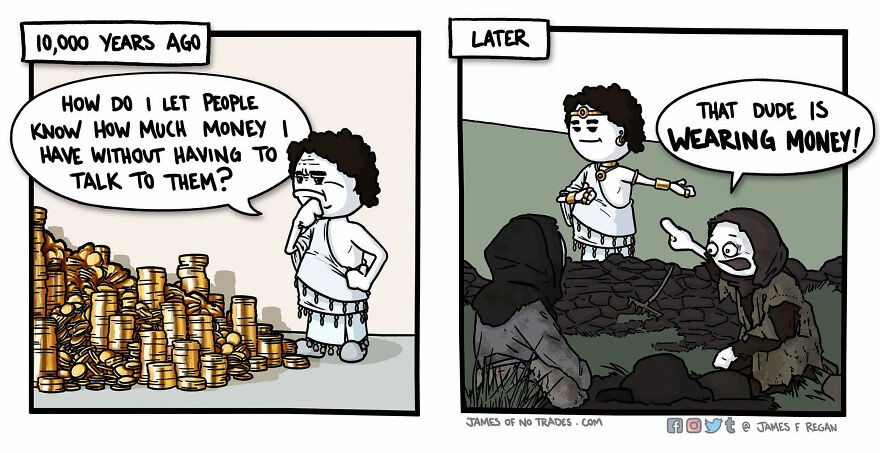
Wasn’t it the other way around with gold coming first?
Yup. Coins are from around ~700 BC. Gold jewelry is thousands of years older.
thousands of years older.
prolly hundreds of thousands… humans were makin jewelry (maybe not with gold) since before they were homosapiens
Technically, money as a term applies to any kind of exchange valuation system, not just currencies and their representations (aka coins and bills and other denominations).
And the history of valuation of exchange goes back to prehistoric times - as long as barter has existed, so has money, even if it wasn’t called officially that.
For example we have records of debt ledgers from ancient Mesopotamia, cca 5000BCE, which tallied goods exchanges that weren’t executed immediately (e.g. one party would offer a dozen eggs in return for a unit of wheat, but the wheat would be delivered months later).
But debt handling goes back even further, tally sticks were used as early as 30000BCE. Yes, even cavemen traded and kept rudimentary records of it.
Mind you these are all “money of account” systems. “Money of exchange” systems - where an intermediary, representative system is used for valuation instead of an account - also developed prior to coin usage. In North Africa, the Mediterranean, and ancient China, units of salt were frequently used for such purpose. In Mexico? Cacao beans. In the Maldives, natives used cowrie shells. Hell, in Ancient Greece and Rome, even slaves were used as money.
Interestingly, the first evidence of gold jewelry - from around 4600BCE to 4200BCE, the exact time being hard to determine with certainty - actually falls around the same time as the Mesopotamian use of trade account ledgers, making it hard to identify which might’ve appeared sooner - however most gold jewelry evidence from the era is located quite further away from Mesopotamia, in current day Bulgaria, meaning the two did not coexist at the same place in the same time (at least presumably), making it so that in some areas, gold jewelry might have appeared sooner than a formalised/codified approach to money of account, and vice versa, in some areas, accounting existed for millennia before good began appearing in use for jewelry or decoration (e.g. in Mesopotamia, the oldest discovery of gold use is dated to around 2500BCE).
But ultimately, humans of all eras, even prior to tool use, liked to adorn themselves with things they found pretty, and pretty things thus have always held value even if not officially codified, so I think we can state with confidence that gold jewelry and gold as money more or less come hand in hand in history.
- King Arthur: Well, I am king.
- Dennis: Oh, king eh? Very nice. And how’d you get that, eh? By exploiting the workers. By hanging on to outdated imperialist dogma which perpetuates the economic and social differences in our society. If there’s ever gonna be any progress…
[…]
- Dennis: I told you, we’re an anarcho-syndicalist commune. We take it in turns to act as sort of executive officer for the week…
- King Arthur: Yes…
- Dennis: …but all the decisions of that officer have to be ratified at a special bi-weekly meeting…
“Shut up! Shut up! I command you to shut up!”
“Help! Help! I’m being repressed! See the violence inherent in the system!”
"Who’s that, then?“
“I dunno. Must be a king”
“Why?”
“He hasn’t got shit all over him.”
Let’s mug 'em!
That, or wearing conspicuous amounts of fabric such as a toga in a time when producing it was very time-intensive and accordingly expensive, particularly white fabric since keeping things white without modern detergent was a little harder and even more so when dyed in colors only attainable with exotic materials such as purple. Either you had the leisure to do these things yourself (because you don’t have to work for a living), or you had the wealth to pay someone else for it.
"We don’t have a looorrd."
Nowadays it’s an iphone