It’s pronounced like yiff. I have spoken.
Gif is obviously pronounced like the g’s in ‘gorgeous’
Honestly have never understood the gif debate. Words sometimes have multiple pronunciations. They’re both fine.
it’s an acronym (as opposed to initialisms, which are not pronounced as a single word). There is no rule on pronunciation.
scuba nato laser
We don’t do this for any other acronym. There is no rule about the pronunciation. It’s arbitrary. The creator chose “jif”, so that’s the “canonical” one.
Gif is pronounced like gist, giraffe, gibberish, ginger, and gin
Jxl is pronunciation beeg jay-peg because Jay is lucky
Take the word “gift”. Say the word, but stop before you get to the last letter. What letters did you say? What sound came out of your mouth? Case closed.
Take the word “applet”. Say the word, but stop before you get to the last letter. What letters did you say? What sound came out of your mouth? Case closed.
That’s still pretty close.
I don’t know how you say those words then
For me it would be App-Le vs Ap-pull
We should just go ahead and pronounce all acronyms the way their unabbreviated forms’ first syllable letters are said. Just ignore we treat individual letters differently than the words they came from.
The CIA should sound like “see ya” Department of Transportation “Duht” Internal Revenue Service “ears”
Etc.
Dept of Transportation would be “dot”, no?
People tend to pronounce “of” more like “uhv” in shove or glove, not like stove or clove. So I went with “duht” for pronunciation.
It’s pronounced Gif, with a soft G as in Graphics.
I don’t give a fuck what the idiot creator thinks it should be pronounced as, I’ll die on this hill with my honor intact, surrounded by the corpses of everyone who thinks Jif is referring to anything but peanut butter.
You say soft g when you mean hard g. Hard g’s include GOAT, game, dragon, and gangster. And gif.
The peanut butter is exactly the reason he picked that pronunciation. Choosy developers choose gif.
It’s interesting debate to observe from my perspective as my native tongue has no different pronunciations for letters, they are always the same regardless of their placement in words. G is always pronounced the same, and so is P. (Spoiler: it’s hard G and hard P).
This brought another thing in my mind about soft G. Let’s take for example Gin, which is with soft G I believe (it’s hard G here because there is only hard G). Then there is the acronym GT for Gin & Tonic. The question is, in English language countries, is the acronym pronounced jay-T instead of gee-T?
All English is based on etymology which is why it’s such a hard language to learn. Looking at how a word is spelled always takes second place to where it comes from.
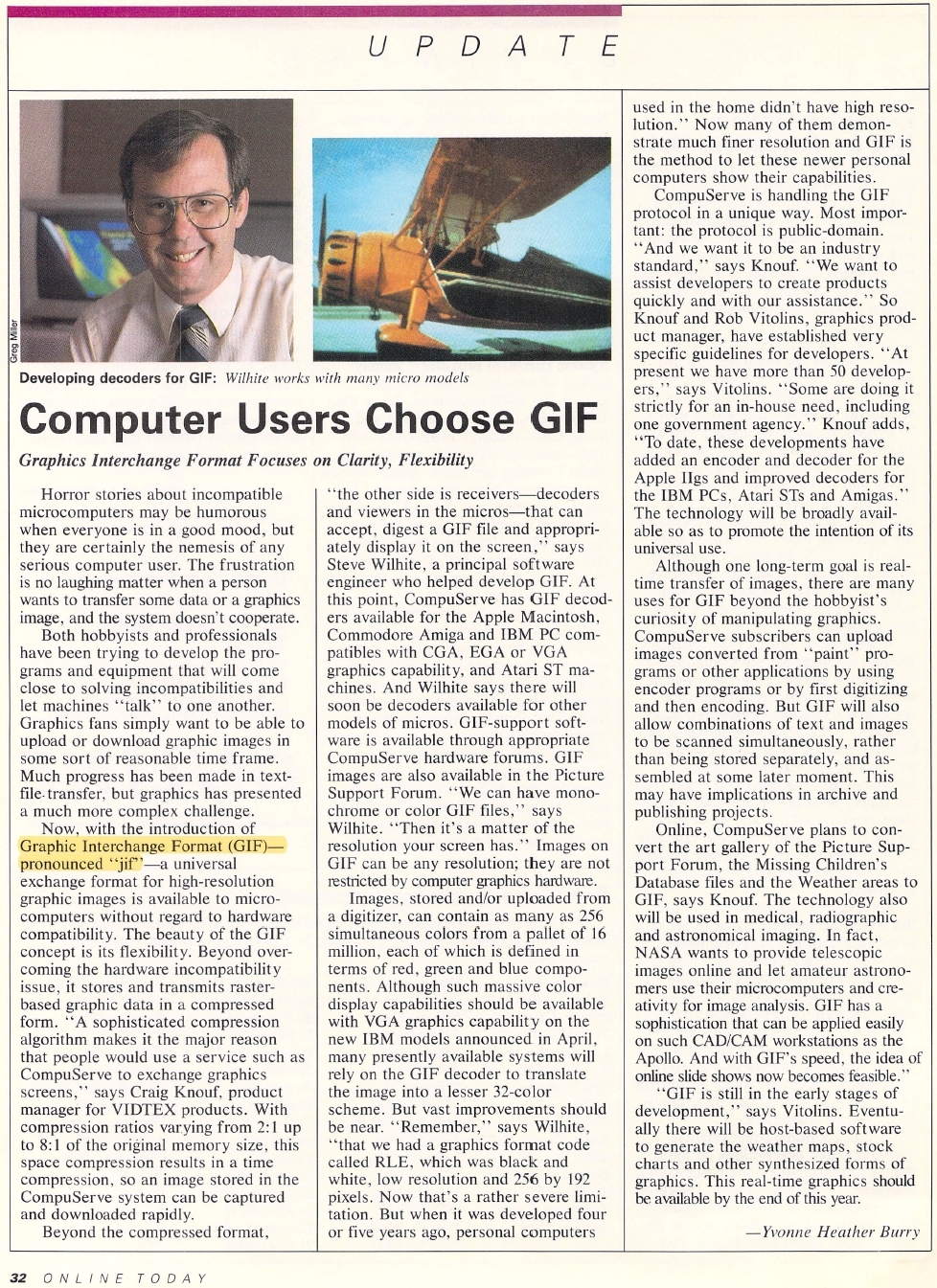
GIF was pronounced with soft g since it came out, back in the 80s/90s when it was shared on AOL and CompuServe. Year, decades, later it came back into social media with Reddit and Twitter, and people pronounced it based on what it looked like it would sound like, which is most similar to hard g like gift.
That doesn’t mean GIF never had a soft g. It just shows how old you are or when you discovered it when you use the hard g.
GIF was pronounced with soft g since it came out, back in the 80s/90s when it was shared on AOL and CompuServe.
FWIW, in the 80s & 90s, everyone I knew pronounced it with a hard G, including folks at computer shows, which my family used to go to frequently.
To me, the soft g ‘jif’ pronunciation is the new Internet fad, not the other way around.
https://www.olsenhome.com/gif/compuserve-big.jpg
Since it was announced in 1987, if they mentioned the pronunciation it was soft G. The inventor and CompuServe would tell you it was soft G. CompuServe’s applications would tell you if soft G in their docs.
It’s even in the documentation of PNG which came out 7 years later that says soft G is correct in GIF, and they wanted people to pronounce PNG as “ping”, not “pinj”. (Yes, really)
See https://www.olsenhome.com/gif/ for more examples.
Looking at how a word is spelled always takes second place to where it comes from.
Where it comes from matters less than historic pronunciations.
“Lawn-jer-ay” is how most of the English word pronounces “lingerie” even though that’s nothing like how it’s pronounced in French, nor is it anything like what you’d pronounce if you sounded out those letters assuming it was an English word.
“Lieutenant” is pronounced completely differently in the UK vs the US. It’s etymology is also French, but neither English pronunciation is at all close to the French. Somehow the British get an “f” sound in there, which can’t be explained by spelling or etymology, and somehow the American pronunciation turns “ieu” into an “oo” sound.
As for “gif”, the “aol and compuserve” thing shows the problem: text based forums. The first time people encountered the word was by reading it. As an unfamiliar word, they mostly went with the common English rule of finding similar words. In this case, the only other words with “gif” are “gift” and words based on “gift”. Since that has a hard G, from the very start people have been using the hard “G” sound.
Why don’t you just pronounce it “gee-eye-eff”?
That’s what I do. If somebody’s gonna be pissed no matter how you pronounce it, might as well piss them all off equally.
I’m just going to say “graphic interchange format” from now on.
Funny enough, that has both a hard g and a soft g in it.
Yes!
I’ve always been in the “jif” camp.
Now I have a new counter!
What do you fall back to when they just agree that “jay-pheg” is the only reasonable pronunciation?
Dunno. Haven’t had the chance to try the argument.
But like, I’ve literally never heard someone say “jay-pheg”.
Somehow, I can tolerate “jpheg” much easier than the forsaken “jif.”
Jif is where it’s at. Peanut butter and image format? Yes please
The creators literally referenced this early on “choosy devs choose gif” like the jiff peanut butter commercial.
Oh my God no one fucking cares about Steve Wilhite and his fucking speech impediment.
You seem upset.
Yes, and that’s stupid.
It’s not ‘Jraphical Image Format’. Gah!!!
“Jif” is the original pronunciation. It is a pun, a play on the word “jif” short for “jiffy” meaning a short amount of time, as in “I’ll send it to you in a gif”. The newer pronunciation has become popular based on the fallacious reasoning that an acronym should be pronounced the same as its constituent words, which isn’t a thing at all.
Language evolves, and both pronunciations are common enough to be considered acceptable. The only way to be wrong about how to pronounce the word is to claim one of the pronunciations is wrong.
The newer pronunciation has become popular based on
The newer pronunciation has become popular based on their internalization of the obscure patterns of English pronunciation, informed by the most similar word: “gift” which uses a hard g. Everyone I know of started saying it with a hard g because that’s what made sense based on the spelling, long before hearing the weird thing about constituent words.
Nobody pronounced LASER as Lah-seer, which you’d have to do if you used “A as in Amplification” an “E as in Emission”.
OK but there are other similar words that start with gi like giraffe and gigolo, but really that’s not why I or anyone I knew in the 90s started using the soft g to say “gif.” We did so because we learned about the format, and said “Neat, what’s it called?” and they said “it’s called a gif” because that was the name of the format. We didn’t debate the pronunciation because it had been given a name, the same way you don’t ask a person you just met “Shouldn’t ‘Bob’ be pronounced with a long ‘o’ like the very similar name ‘Job’? I’m going to call you ‘Bobe’ because that makes more sense to me.” You’d have to be a massive douche to say that out loud to a person who had just introduced themselves.
If someone said it with the hard “g” we just nodded and went about our day because it doesn’t matter, we knew what they probably meant and they just hadn’t read the manual.
Pronunciations change over time, and that’s good. Language is a function of communication, and better communication is what enabled humans to transfer knowledge. If someone uses the soft g, you know the word they’re saying, and I know you’re probably not saying the word “gift” from context. We’re communicating either way, and we don’t have to pronounce every word the same.
Case in point, I don’t say “emission” with a long “e” sound, I say “ehmission” because it doesn’t matter that much.
The only way to be wrong is to claim that someone else is saying it wrong.
“Neat, what’s it called?” and they said “it’s called a gif”
Yeah, and then we all assumed it was pronounced “gif” not “jif” because the only other word with the letters “gif” was “gift” and that had a hard g. Later on, someone claimed it was supposed to be pronounced “jif”, but we all laughed at that idea and kept using the correct pronunciation.
We didn’t debate the pronunciation because it had been given a name
Neither did we, it was a hard g. There was no debate. Sure, some people claimed it was supposed to be a soft g, but we all laughed at that idea because it was ridiculous.
We didn’t debate the pronunciation because it had been given a name, the same way you don’t ask a person you just met “Shouldn’t ‘Bob’ be pronounced with a long ‘o’ like the very similar name ‘Job’?
I’m guessing you’re not multilingual then, because I am, and it’s extremely common to change how someone’s name is pronounced. People with the name “David” who are French are used to the French pronunciation of their name being “Dah-veed” but in English “Day-vid”. French people pronounce “Bob” as “Bub”. It’s good to allow people to slightly change how your name is pronounced because it flows better in their language. If they have to pause every time your name comes up to adapt how it’s said, it just makes things more difficult.
As for “gif”, if someone pronounced it as “jif”, we giggled a bit, but that’s it. It was only if someone was really insistent that it had to be a soft g that we really laughed. Some people tried to claim that the creator of the format had wanted a certain pronunciation, but we knew that didn’t matter.
Language is a function of communication, and better communication is what enabled humans to transfer knowledge
Exactly, and part of good communication is good pronunciation, because if you mispronounce things it makes it harder for people to understand you. If you insist on using a nonsensical pronunciation then you’re just trying to make it hard to communicate with you.
That is the most anti-linguistic take ever lmao. There is no such thing as an objectively correct pronunciation, both pronunciations of “gif” are valid in the context of most English conversations.
On another note, the guy who created it said it’s pronounced /dʒɪf/, so if any pronunciation is more “correct” it’s the one you hate. It’s not “some people tried to claim”, that’s what it actually is “correctly” pronounced like according to the only one that can come close to being considered an authority on what the correct pronunciation is.
Your comment being so pretentious and stuck-up about you not liking a pronunciation leads me to believe you’re making the whole “we” thing up, and instead of a group of people being dumbasses and laughing at a correct pronunciation, it was just one person (you) malding about it in their head. Because being the kind of person to actually laugh at something like that in real life, face to face, would be too embarrassing for anyone to actually go through with it. God even just reading your comment makes me feel like I’m looking at made-up Reddit stories again…
Also how people speaking other languages handle names doesn’t have anything to do with this, there’s a big difference between calling someone “wrong” for pronouncing a loanword differently than in the parent language because of the languages’ phonetics & phonotactics not aligning with each other, and insisting that everyone else is “wrong” because their completely linguistically valid, common pronunciation challenges your understanding of the language.
Oxford uses /dʒɪf/ as the primary pronunciation with /gif/ as the secondary in most of their resources (although a lot don’t specify a primary or secondary), Dictionary.com lists /dʒɪf/ as the primary pronunciation, some like Merriam-Webster list both equally, Cambridge less consistent but list both. Clearly the people who’s job is language disagree with you, even if you don’t want to ask for linguists to tell you, they literally make the language references you use. If you want to be stubborn and insist on being wrong, so be it.
You can now continue malding about the fact that you use the incorrect pronunciation for the rest of your life, since apparently that’s how you see language.
There is no such thing as an objectively correct pronunciation
But, there are patterns to the language and using a soft “g” sound doesn’t follow those patterns, so it’s objectively a less correct pronunciation.
the guy who created it
Who cares about that guy? He made a mistake, he should have looked up how words are pronounced before trying to get people to mispronounce “gif”. If he’d said it was supposed to be pronounced “dug” people would have just ignored him, but his attempt wasn’t that absurd, it was just slightly wrong, so not everyone ignored him the way they should have.
instead of a group of people being dumbasses and laughing at a correct pronunciation
It really sounds like you didn’t have friends. The rest of us did.
Also how people speaking other languages handle names doesn’t have anything to do with this
Of course it does. How you pronounce things depends on the language you use. How people pronounce the letters “gif” is based on their language. In English, it’s a hard g.
But, there are patterns to the language and using a soft “g” sound doesn’t follow those patterns, so it’s objectively a less correct pronunciation.
Who makes these mystical “rules” that English surely follows? And who says the patterns you see are objectively more correct, there are a ton of other words with “g”/“gi” that pronounce it with a /dʒ/, you have to do some real mental gymnastics to justify one of them being more correct. There is a point where you have to paint a massively arbitrary line to which patterns are more “correct”, it is a completely subjective matter.
Who cares about that guy?
He’s the only one that can be considered an authority on how the word is pronounced LMAO.
He made a mistake, he should have looked up how words are pronounced before trying to get people to mispronounce “gif”.
Pronunciation isn’t based on spelling, it’s the other way around. Writing is a tool made to accomodate language, and said writing isn’t a pronunciation guide. You’re lobotomized if you think otherwise, especially in English. But regardless, see below.
If he’d said it was supposed to be pronounced “dug” people would have just ignored him, but his attempt wasn’t that absurd, it was just slightly wrong, so not everyone ignored him the way they should have.
But he didn’t pronounce it like “dug”. He pronounced it consistently with another common 3-letter word “gin”. Is “gin” wrong now? You can cope with being wrong all you want, but it doesn’t make you less wrong.
It really sounds like you didn’t have friends. The rest of us did.
Yeah no that writing reads like a fake Reddit story, I refuse to believe even the dumbest teenagers would act like that.
Of course it does. How you pronounce things depends on the language you use. How people pronounce the letters “gif” is based on their language. In English, it’s a hard g.
The English writing system isn’t the English language, and the English writing system isn’t consistent enough to make estimations for a pronunciation like that. The only two words in the language that contain “gif” are “gift” and “fungiform”, plus derivatives of course, the latter of which is generally, by standard, pronounced with a /dʒ/ sound. If you think that’s enough basis to go off of to make rules for every other word containing “gif”, and then insist that your pronunciation is “correct”, that’s a you problem.
The same goes for any language – German has mostly-consistent generalized spelling conventions for the language that approximate pronunciation, but a LOT of common words break this convention, including “guken”, “orange”, the ending “-ig”, “toilette”, “vase”, etc. which are pronounced differently than their spelling would lead you to believe. In fact it is most common for Fremdwörter & Lehnwörter to not be spelled typically. Is every German speaker pronouncing those words wrong now? What about Italian languages, which often do the same thing but significantly more? You can look at less and less standardized languages that contain more and more irregularities, until you get to a language like English and see that the “irregularities” in the writing system completely outweigh any actual “regularities” you see and it becomes completely pointless to try to enforce a pronunciation based on a certain spelling. It’s why people learning a language like English or Tibetan or even Danish will have often cite the spelling as an extreme pain point (I can corroborate the first based on my experience teaching ESL), it is an inconsistent orthography where the spelling is almost entirely dependent on the etymology or something else, rather than any current pronunciation.
It’s also convenient how you left out the entire part about the dictionaries. Almost as if that was a silver bullet for your flawed argument and you can’t acknowledge it because it would make you look too crazy. Because the people who are the most looked up on for “correct” language by most English speakers say you’re wrong. Hmmm.
When you consider that a large number of words in English which are spelled the same have different pronunciations or are pronounced wildly phonemically differently by different speakers or in different dialects, like “minute”, “combat”, “perfect”, “read”, “bass”, “close”, “agape”, “object”, “sewer”, “wind”, “wound”… “apricot”, “leisure”, “often”, “crayon”, “either”, “been”, “caramel”, “garage”, “yogurt”… your argument about pronunciation based on “spelling rules” falls apart pretty quickly.
Present your argument on how English works to any linguists or even anyone who has basic knowledge of linguistics and you’ll be laughed out of the room.
Become popular? It’s been popular roughly for the lifespan of the format. It’s hardly language’s fault the developer wanted to make an unfunny reference to a since forgotten peanut butter slogan.
On the other hand linguistics indicate a hard g sound with the construction of the word, constituent words aside. Plenty of four letter words starting with the gi combo have a hard g, including but not limited to gift which you may notice is very similarly constructed.
Whatever else the English language may throw at us, people appreciate consistency because we can make some sense of the world. A hard g is the consistent, predictable, sensible choice for the limited availability of those virtues English offers.
Become popular? It’s been popular roughly for the lifespan of the format.
I’m gonna stop you there, because I’ve been using the format for about 30 years, and people only started using the new pronunciation in the last 10-15.
Everything you said about linguistics is entirely crap. English is not a proscriptive language. English linguistics doesn’t indicate anything at all. It is descriptive, and is anything but consistent. There are no rules about word construction or pronunciation. Words are pronounced the way they are understood, and if you are understood then you have pronounced them correctly.
You could argue that the original pronunciation is archaic, like “encyclopaedia,” but the problem there is that the word itself is like 35 years old, and there are people like me who have been using the word since there was only one acceptable pronunciation who aren’t likely to change.
people only started using the new pronunciation in the last 10-15.
As someone else pointed out already, this is untrue. While it may not have been popular in your circles, it definitely was in others. I’ve been saying it with a hard g as long as you have with a soft and I’m not the originator either.
English linguistics doesn’t indicate anything at all.
They absolutely do. That’s why you can sound out a word you’ve never seen before. You may not always be right when you do because they indicate, they don’t define.
There are no rules about word construction or pronunciation.
There are, there are just exceptions. For example, an e at the end of the word is silent. I’m certain you can give me a word where it’s not, but there are at least six in this paragraph alone where it is.
if you are understood then you have pronounced them correctly
In this logic if someone has been pronouncing a word all their life with a single pronunciation and travels to another location with a much different accent they can only now be pronouncing the word wrong.
If understanding is also the only metric then a hard g would still be preferable. Not only does a written g tend to make people lean to a hard g in my experience, but there’s more words that could be mistaken for a soft g pronunciation.
You could argue that the original pronunciation is archaic,
Could I not argue that the original pronunciation has fallen out of favor?
the word itself is like 35 years old
Is there a time requirement for pronunciations to become archaic?
since there was only one acceptable pronunciation
Which isn’t a time that existed, as we’ve established
who aren’t likely to change.
Given your stance on language this is absolutely a you problem. If the rest of us collectively decided to understand it as only with a hard g, you would not be understood and therefore be pronouncing it wrong by your own logic.
I’ve never had the problem of not being understood. And regardless of how long the time period was, there was a time when one guy spoke aloud the word when he invented it. You can use the new pronunciation if you like, but I use the original, as I have for 30+ years, and I will continue to do so because both are acceptable. If you don’t like it, that’s a you problem.
There are, there are just exceptions. For example, an e at the end of the word is silent. I’m certain you can give me a word where it’s not, but there are at least six in this paragraph alone where it is.
One of the most common words with a final “e” in that paragraph is “the” which not only has a final “e” sound, but has two different final “e” sounds depending on the context: “the end” uses a /ði/ pronunciation but “the word” uses a /ðə/ pronunciation. English is very stupid.
But, I agree with your assessment. English has rules, or at least patterns. “G” is most often hard, not soft, because “J” is available for the soft version, but there’s no alternative for the hard version. English tends to follow patterns, and “gift” has a hard g, and it (and words based on it) are the only ones that start with “gif”, so every “gif” word is hard. Because “t” (unlike “e”) can’t change the sounds before it, the pattern says that “gif” should have a hard “g”.
If it were “gir”, then there would be more debate. The word “giraffe” has a soft “g” but “girl” has a hard one, so the pattern is more muddy.
Also, people who coin words don’t get to decide how they’ll be pronounced. They can certainly try, but they’ll often lose. There are plenty of words in English borrowed from other languages that not only sound nothing like the original language, but that sound nothing like they’d sound if they were English words. For example, “lingerie”. It’s a French word, but the English pronunciation sounds nothing like a French word. In fact, if someone just sounded out the word as if it were an English word, they’d probably get much closer to the French pronunciation than the awful “lawn-je-ray” which is the current accepted English pronunciation (though, they’d probably assume a hard “g” sound).
In this case, it’s too bad that Steve Wilhite didn’t have a background in linguistics or he would have realized that people would see “gif” and assume a hard “g”. It was a losing fight from the start because he either didn’t understand the assumptions people would have when they saw those letters, or he thought that somehow he could successfully fight the tide all by himself.
Say gift. Now what you’re going to do next is leave out the T but enunciate the gif part the same way. Fuck you jif people!
I’ll tell the agile fragile fugitive gin-drinking giraffes eating ginger ginseng to imagine gingerly using their digits to engineer a geological survey of the gist of your comment. They ate too much gingerbread and now have gingivitis, so the margins of those attracted to religion aren’t as rigid as the original origins of those of that region and we have to remain vigilant lest magic supersede logic, which of course would be terrible for legislation of the legions.
Great.
However none of those have the g-i-f sequence and have the j sound.
They do have g-i-t sequences. So it suggests that the f makes the g pronounced like a g not a j.
Intact, you could use examples like “digit” to argue the versioning software should be pronounced jit.But git is literally a word (and it’s pronounced with a hard G).
https://initialcommit.com/blog/How-Did-Git-Get-Its-Name
Yeh, it’s obviously a nonsense argument.
Linus even suggested 2 backronyms for it, none of which have the j sound.
And there is precedence for git being pronounced git not jit.
However none of those have the g-i-f sequence and have the j sound.
So the criteria for pronunciation is other words that have the exact same letters? What does that mean for the pronunciation of “women”?
Women Vs world? Women Vs Woo? Women Vs work? Women Vs wonder?
Cause the “wom” sequence would be…
Women Vs Womb?
Women Vs Wombat?The arguement is obviously nonsense.
It’s going into syntax of words to get pronunciation, instead the acronym/name.
Which is funny, because that’s exactly what’s happening in the gif/jif argument.
Say gigantic. Now what you’re going to do next is stop with your ANTICs and enunciate the gig the same way.
Ironic since gig is already a word and everyone agrees it’s pronounced the other way.
The whole thing is funny when you look at the full phrase too. Graphical Interchange Format – it’s got both a hard g and a soft g. You could call a gif an image. You could also call it a graphic.
At the end of the day, there really isn’t an answer, and there never will be. It’s a fun debate to fuck around with though
There is a G sound and there is a J sound.
There is no need to invent a distinction between “hard” and “soft” G. A “soft G” is just a J.
G can make a hard G sound or a soft G sound, the soft G is identical to J.
It’s still a soft G sound though, because the letter is G.
No, it’s just a G that is making a J sound.
GIF is pronounced GIF not because the G stands for Graphical, but because it is its essence. It is what is calls out to be… Called.
And because it’s not peanut butter.
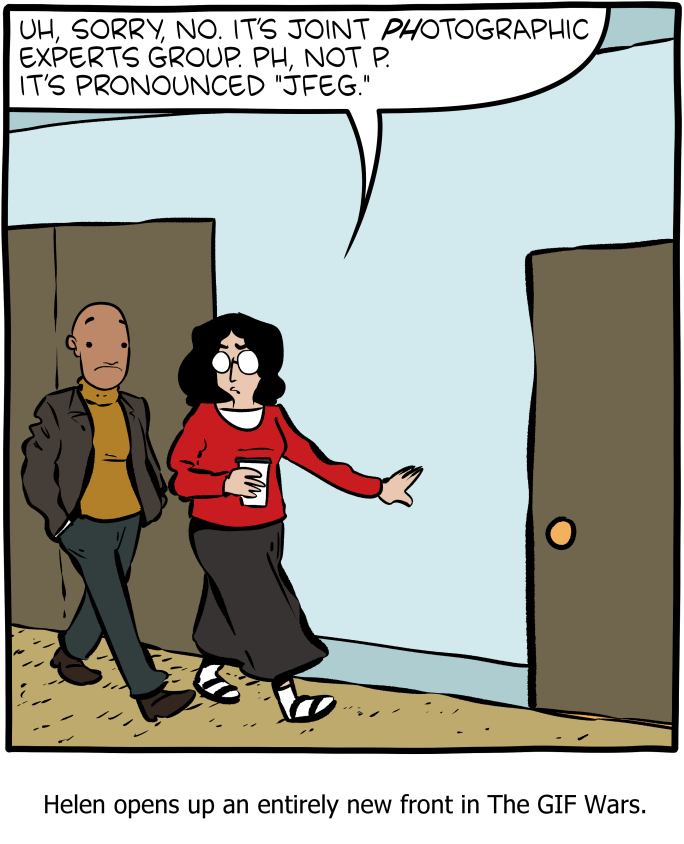
And for the same reason, JPEG is pronounced JFEG not because the P stands for Photographic, but because that is the expression of its true essence.
I just didn’t know it before today.
Justice for JΦEG!
Also, “gi” in english makes the hard g sound very often, like in gift, or give, or giddy. You need to do some real mental gymnastics to justify it as a j sound
giant, gigantic, ginger, gist, gin, giraffe, gibberish, gingivitis, giblet, giro, giron, gingal, gipsy / gitano, gingili, gigot, girasole, giaour, …
logic, tragic, agile, agism/aging, legit, sigil, magi, magic, argil, algid, aegis, vagile, algin, digit, legible, legislature, surgical, intellegible, …
looks like a lot of palatal affricates to me dawg idk, i think you’re the one doing mental gymnastics trying to justify it not being pronounced the way the creator specified. “gif” the way you ask for just sounds weird
Say the word “gift”. Don’t pronounce the t. Wow. That simple.
Say the word “giraffe”. Don’t pronounce the ra. Wow. That simple.
The giant ginger biologist originally apologized for being allergic to ginseng.