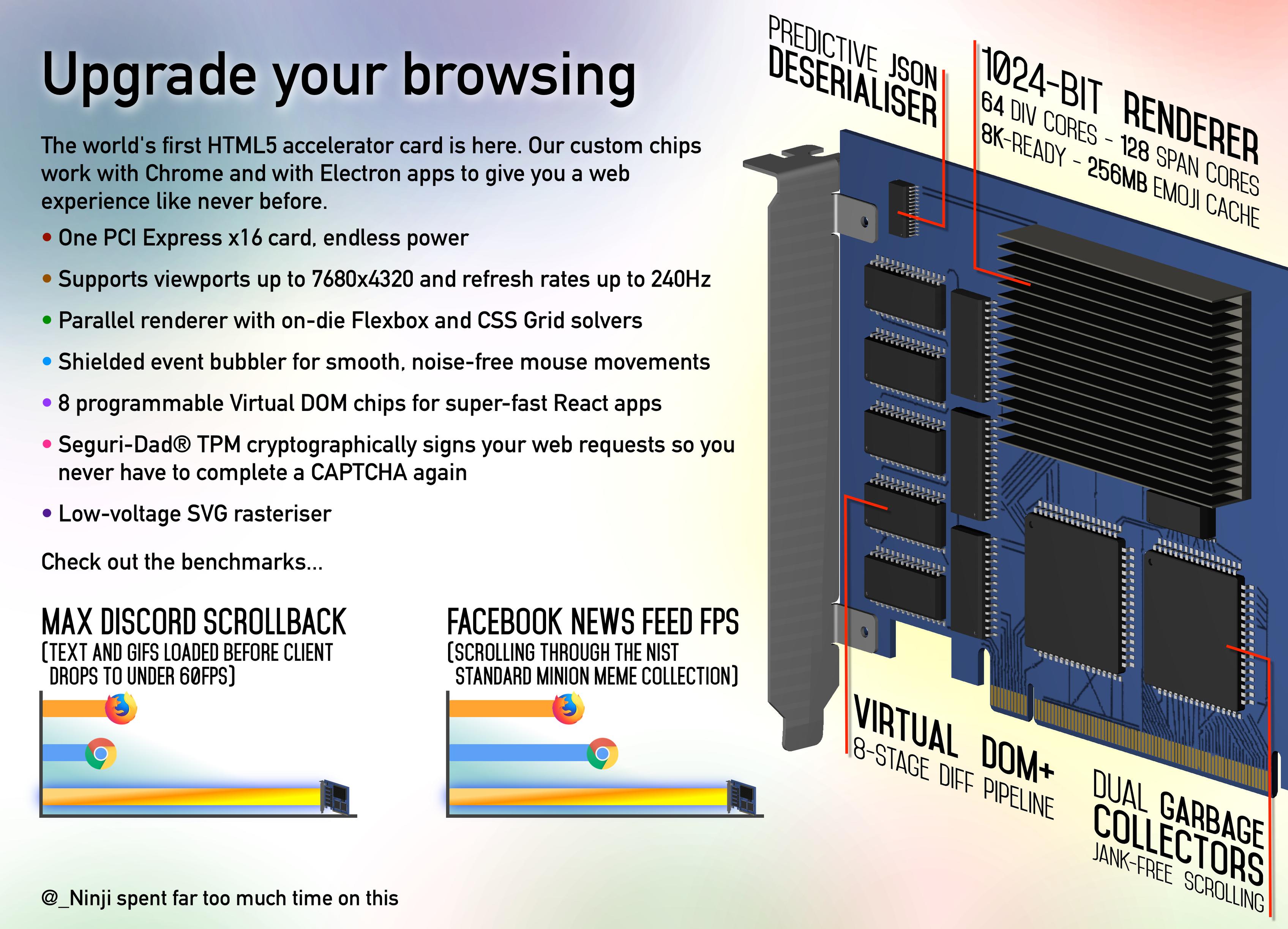
I know this is a joke - but there totally is hardware acceleration for some of this stuff in modern processors. There definitely is for JS, JSON and generally string stuff. It’s not even x86 only, ARM got these kinds of things as well (although likely less of it)
Hardware acceleration for an interpreted programming language? Can you point me to a specific example or clarify what you mean, because I find that hard to believe.
I’m not sure what they were going for, but I know that modern browsers do just in time compilation for regularly repeated code parts to allow much faster execution, so “interpreted programming language” may be a little of a blurry definition. See https://developer.mozilla.org/en-US/docs/Glossary/Just_In_Time_Compilation
I couldn’t find any info on any hardware specific to JS/JSON for clients but I’m no expert, maybe they will provide more info.
Removed by mod
The 8088 CPU (the one from the original IBM PC) had special string scanning support with both instructions and registers. The SI (source index) and DI (destination index) were such registers, and a bunch of instructions related.
However, specialized instructions take die area on the CPU. In the 1980s a movement based on the observation that most sophisticated instructions were not used much, and it would be better to concentrate on making very common operations (like add, load, store, shift, or whatever) fast. That started reduced-instruction set computing (RISC).
RISC was so successful that x86 chips switched to the model with a RISC-like core and implementing more sophisticated fuctions in “microcode”. Today Linux can load microcode, which is basically patching the firmware of the CPU itself.
Anyway, of course the drive towards RISC ended as people realized that some advanced functionality is really useful. In the 1990s and 2000s this was focused around new limitations: it was impossible to get higher frequencies so running a single core couldn’t get faster. CPUs added SIMD (single instruction, multiple data) support as well as hyperthreading.
Now… revisiting string operations and adding CPU support would be possible. Engineers at CPU design shops look at how their chip space is used and optimize the die area for instruction sets and also registers, cache, and so on. But my guess is that it doesn’t make sense or it would have happened a decade ago already.
What’s amazing is that actually everything in there could be doable unironically.
But more amazing (and embarrasing) is the fact that we have reached to this point where optimization is that undervalued by most programmers. Horrible timeline to live in, when AI is messing up with hardware prices.
I wish I didn’t know developers who would look at this and go “What’s the joke? Sounds like a good idea.”
Guilty.
95 percent of the people using computers are just using them for a browser.
Let’s implement the DOM in hardware!
Let’s implement a web without DOM-abused-as-GUI.
Nothing quite like locking yourself further into a broken, patched together frankenmess forever based only on momentum.
Needs 2x 10GbE ports to download bloated React apps directly into its onboard cache. Otherwise perfect.
I love the idea that somebody at NIST is in charge of collating a Standard Minions Meme Collection.
I want that thing to never do a captcha again, please
With catptchas becoming more and more common as sites try to stop AI crawlers, I suspect that’s going to become a real thing…
A real thing that irrevocably identifies you online, with absolutely no anonymity, and costs $9.95 per month, and only works on Cloudfare captchas.
Damn do you need 64gb of sweet DDR5 to run this
Ok but how bad does it get when the 256MB emoji cache is full? Cause that’s not enough space for all my emoji.