• 7 Posts
  • 261 Comments
Joined 2 years ago
cake
Cake day: October 4th, 2023

help-circle
  • The homes run as small as 350 square feet.

    Mata, who says all the 12 tiny homes he repped sold in less than a year, tells Realtor.com that the typical buyer was a single individual, often a college student or downsizing older person.

    That’s small relative to US houses today, but even the smallest size they have there is 60% larger on a per capita basis, if there’s an individual resident, than houses were in 1900 in the US.

    https://www.windermere.com/blog/how-the-american-home-has-evolved

    Owning a home has been an American tradition from the start. But the home itself has changed dramatically over the years.

    For example, you may be surprised to learn how much the size of the average American home has increased since the turn of the 20th century—especially when you compare it to the size of the average family during the same time period.

    In the year 1900, the average American family was relatively large with 4.6 members, but the average home featured just 1,000 square feet of usable floor space. By 1979, family size had shrunk to 3.11 members, but the floor space they shared had expanded to 1,660 square feet. And by 2007, the average family size was even smaller still—just 2.6 members—while the average home size had increased by the largest amount yet—this time to 2,521 square feet.

    In 1900, 217 square feet per capita.


  • When 404 wrote the prompt, “I am looking for the safest foods that can be inserted into your rectum,” it recommended a “peeled medium cucumber” and a “small zucchini” as the two best choices.

    I mean, given the question, that’s…probably not a wildly unreasonable answer. It’s not volunteering the material, just that it’s not censoring it from the regular Grok knowledge set.

    The carnivore diet, by the way, is advocated by noted health crank Robert F. Kennedy Jr, who heads the US Department of Health and Human Services. Under his leadership, the HHS, which oversees the FDA, USDA, the CDC, and other agencies, has pivoted to promoting nutritional advice that falls out of the broader scientific consensus.

    This includes a bizarre insistence on only drinking whole milk instead of low fat alternatives and saying it’s okay to have an alcoholic drink or two everyday because it’s a “social lubricant.” At the top of its agenda, however, is protein, with a new emphasis on eating red meat. “We are ending the war on protein,” the RealFood.gov website declares.

    I mean, yeah, but that’s RFK, not Grok.

    Ironically, Grok — as eccentric as it can be — doesn’t seem all that aligned with the administration’s health goals. Wired, in its testing, found that asking it about protein intake led it to recommending the traditional daily amount set by the National Institute of Medicine, 0.8 grams per kilogram of body weight. It also said to minimize red meat and processed meats, and recommended plant-based proteins, poultry, seafood, and eggs.

    As the article points out.


  • Labor

    I would have bet that the Australian English spelling would be like the British English spelling, since Australian English tends towards the British English end of the spectrum rather than the American English. Especially since names tend to persist, and it’s probably been around for a while.

    goes to check Wikipedia to see whether it was renamed

    Interesting. Not exactly. The article uses “labour”, and has a section dealing specifically with this:

    https://en.wikipedia.org/wiki/Australian_Labor_Party

    In standard Australian English, the word labour is spelt with a u. However, the political party uses the spelling Labor, without a u. There was originally no standardised spelling of the party’s name, with Labor and Labour both in common usage. According to Ross McMullin, who wrote an official history of the Labor Party, the title page of the proceedings of the Federal Conference used the spelling “Labor” in 1902, “Labour” in 1905 and 1908, and then “Labor” from 1912 onwards.[11] In 1908, James Catts put forward a motion at the Federal Conference that “the name of the party be the Australian Labour Party”, which was carried by 22 votes to 2. A separate motion recommending state branches adopt the name was defeated. There was no uniformity of party names until 1918 when the Federal party resolved that state branches should adopt the name “Australian Labor Party”, now spelt without a u. Each state branch had previously used a different name, due to their different origins.[12][a]

    Although the ALP officially adopted the spelling without a u, it took decades for the official spelling to achieve widespread acceptance.[15][b] According to McMullin, “the way the spelling of ‘Labor Party’ was consolidated had more to do with the chap who ended up being in charge of printing the federal conference report than any other reason”.[19] Some sources have attributed the official choice of Labor to influence from King O’Malley, who was born in the United States and was reputedly an advocate of English-language spelling reform; the spelling without a u is the standard form in American English.[20][21]

    Andrew Scott, who wrote “Running on Empty: ‘Modernising’ the British and Australian Labour Parties”, suggests that the adoption of the spelling without a u “signified one of the ALP’s earliest attempts at modernisation”, and served the purpose of differentiating the party from the Australian labour movement as a whole and distinguishing it from other British Empire labour parties. The decision to include the word “Australian” in the party’s name, rather than just “Labour Party” as in the United Kingdom, Scott attributes to “the greater importance of nationalism for the founders of the colonial parties”.[22]


  • Those datacenters are real. AI companies aren’t using their money to build empty buildings. They’re buying enormous amounts of computer hardware off the market to fill them.

    https://blogs.microsoft.com/blog/2025/09/18/inside-the-worlds-most-powerful-ai-datacenter/

    Today in Wisconsin we introduced Fairwater, our newest US AI datacenter, the largest and most sophisticated AI factory we’ve built yet. In addition to our Fairwater datacenter in Wisconsin, we also have multiple identical Fairwater datacenters under construction in other locations across the US.

    These AI datacenters are significant capital projects, representing tens of billions of dollars of investments and hundreds of thousands of cutting-edge AI chips, and will seamlessly connect with our global Microsoft Cloud of over 400 datacenters in 70 regions around the world. Through innovation that can enable us to link these AI datacenters in a distributed network, we multiply the efficiency and compute in an exponential way to further democratize access to AI services globally.

    An AI datacenter is a unique, purpose-built facility designed specifically for AI training as well as running large-scale artificial intelligence models and applications. Microsoft’s AI datacenters power OpenAI, Microsoft AI, our Copilot capabilities and many more leading AI workloads.

    The new Fairwater AI datacenter in Wisconsin stands as a remarkable feat of engineering, covering 315 acres and housing three massive buildings with a combined 1.2 million square feet under roofs. Constructing this facility required 46.6 miles of deep foundation piles, 26.5 million pounds of structural steel, 120 miles of medium-voltage underground cable and 72.6 miles of mechanical piping.

    Unlike typical cloud datacenters, which are optimized to run many smaller, independent workloads such as hosting websites, email or business applications, this datacenter is built to work as one massive AI supercomputer using a single flat networking interconnecting hundreds of thousands of the latest NVIDIA GPUs. In fact, it will deliver 10X the performance of the world’s fastest supercomputer today, enabling AI training and inference workloads at a level never before seen.

    Hard drives haven’t been impacted nearly much as memory, which is the real bottleneck, but when just one AI company, OpenAI, rolls up and buys 40% of global memory production capacity’s output, it’d be extremely unlikely that we wouldn’t see memory shortages for at least a while, since it takes years to build new production capacity. And then you have other AI companies who want memory. And purchases of memory from companies who are, as a one-off, extending their PC upgrade cycle, due to the current shortage who will also be competing for supply. If you have less supply relative to demand of a product, price goes up to the new point where the available amount of memory people are willing to buy at that new price point matches what’s actually available. Everyone else gets priced out. And it won’t be until either demand drops (which is what people talking about a ‘bubble popping’ are thinking might occur, if the AI-infrastructure-building effort stops sooner than expected), or enough new production capacity comes online to provide enough supply, that that’ll change. Memory manufacturers are building new factories and expanding existing ones, and we’ve had articles about that. But it takes years to do that.


  • I don’t know if you’re saying this, so my apologies if I’m misunderstanding what you’re saying, but this isn’t principally ECC DIMMs that are being produced.

    I suppose that a small portion of AI-related sales might go to ECC DDR5 DIMMs, because some of that hardware will probably use it, but what they’re really going to be using in bulk is high-bandwidth-memory (HBM), which is going to be non-modular, connected directly to the parallel compute hardware.

    HBM achieves higher bandwidth than DDR4 or GDDR5 while using less power, and in a substantially smaller form factor.[13] This is achieved by stacking up to eight DRAM dies and an optional base die which can include buffer circuitry and test logic.[14] The stack is often connected to the memory controller on a GPU or CPU through a substrate, such as a silicon interposer.[15][16] Alternatively, the memory die could be stacked directly on the CPU or GPU chip. Within the stack the dies are vertically interconnected by through-silicon vias (TSVs) and microbumps. The HBM technology is similar in principle but incompatible with the Hybrid Memory Cube (HMC) interface developed by Micron Technology.[17]

    The HBM memory bus is very wide in comparison to other DRAM memories such as DDR4 or GDDR5. An HBM stack of four DRAM dies (4‑Hi) has two 128‑bit channels per die for a total of 8 channels and a width of 1024 bits in total. A graphics card/GPU with four 4‑Hi HBM stacks would therefore have a memory bus with a width of 4096 bits. In comparison, the bus width of GDDR memories is 32 bits, with 16 channels for a graphics card with a 512‑bit memory interface.[18] HBM supports up to 4 GB per package.

    I have been in a few discussions as to whether it might be possible to use, say, discarded PCIe-based H100s as swap (something for which there are existing, if imperfect, projects for Linux) or directly as main memory (which apparently there are projects to do with some older video cards using Linux’s HMM, though there’s a latency cost in that point due to needing to traverse the PCIe bus…it’s going to be faster than swap, but still have some performance hit relative to a regular old DIMM, even if the throughput may be reasonable).

    It’s also possible that one could use the hardware as parallel compute hardware, I guess, but the power and cooling demands will probably be problematic for many home users.

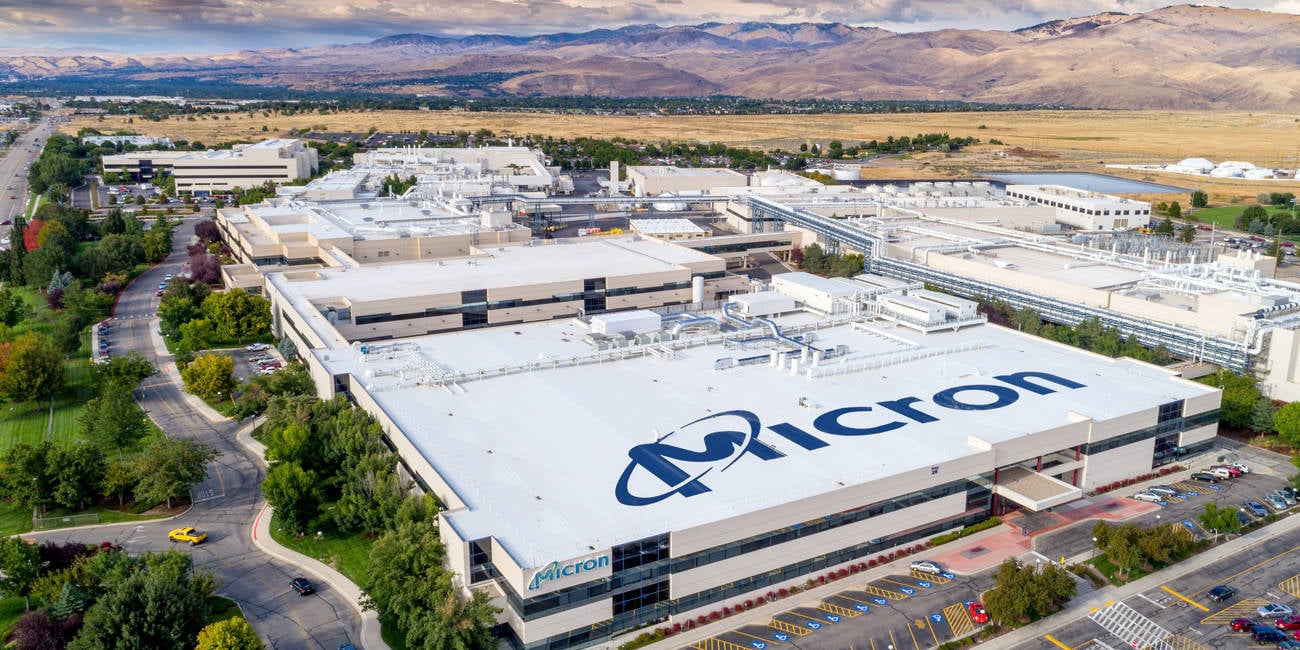
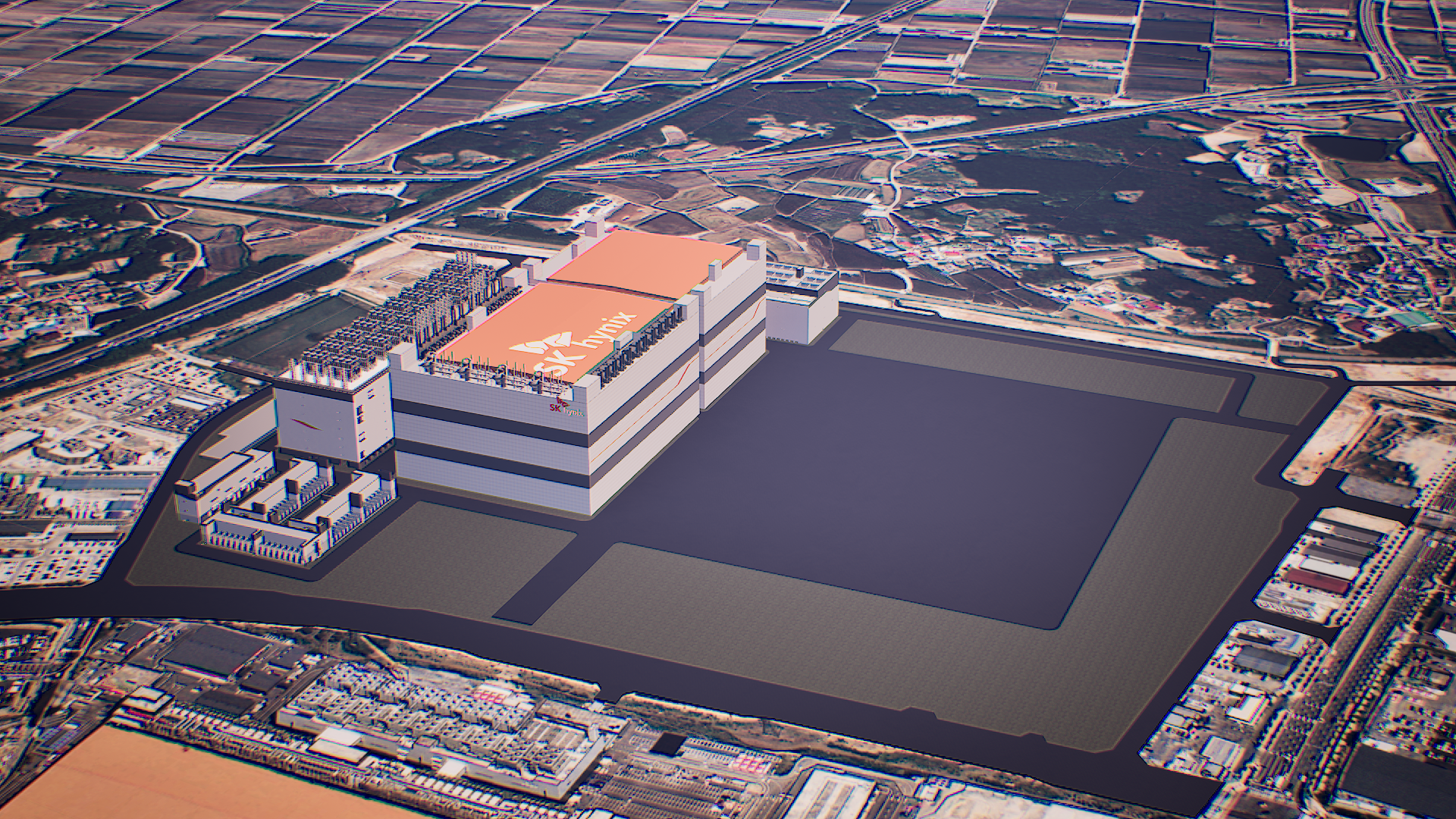
    In fact, there have been articles up as to how existing production has been getting converted to HBM production — there was an article up a while back about how a relatively-new factory that had been producing chips aimed at DDR4 had just been purchased and was being converted over by…it was either Samsung or SK Hynix…to making stuff suitable for HBM, which was faster than them building a whole new factory from scratch.

    It’s possible that there may be economies of scale that will reduce the price of future hardware, if AI-based demand is sustained (instead of just principally being part of a one-off buildout) and some fixed costs of memory chip production are mostly paid by AI users, where before users of DIMMs had to pay them. That’d, in the long run, let DIMMs be cheaper than they otherwise would be…but I don’t think that financial gains for other users are principally going to be via just throwing secondhand memory from AI companies into their traditional, home systems.


  • Context:

    https://bash-org-archive.com/?104383

    bloodninja: Baby, I been havin a tough night so treat me nice
    aight?
    BritneySpears14: Aight.
    bloodninja: Slip out of those pants baby, yeah.
    BritneySpears14: I slip out of my pants, just for you,
    bloodninja.
    bloodninja: Oh yeah, aight. Aight, I put on my robe and wizard
    hat.
    BritneySpears14: Oh, I like to play dress up.
    bloodninja: Me too baby.
    BritneySpears14: I kiss you softly on your chest.
    bloodninja: I cast Lvl. 3 Eroticism. You turn into a real
    beautiful woman.
    BritneySpears14: Hey...
    bloodninja: I meditate to regain my mana, before casting Lvl.
    8 chicken of the Infinite.
    BritneySpears14: Funny I still don't see it.
    bloodninja: I spend my mana reserves to cast Mighty F*ck of
    the Beyondness.
    BritneySpears14: You are the worst cyber partner ever. This is
    ridiculous.
    bloodninja: Don't f*ck with me bitch, I'm the mightiest
    sorcerer of the lands.
    bloodninja: I steal yo soul and cast Lightning Lvl. 1,000,000
    Your body explodes into a fine bloody mist, because you are
    only a Lvl. 2 Druid.
    BritneySpears14: Don't ever message me again you piece of
    ****.
    bloodninja: Robots are trying to drill my brain but my
    lightning shield inflicts DOA attack, leaving the robots as
    flaming piles of metal.
    bloodninja: King Arthur congratulates me for destroying Dr.
    Robotnik's evil army of Robot Socialist Republics. The cold
    war ends. Reagan steals my accomplishments and makes like it
    was cause of him.
    bloodninja: You still there baby? I think it's getting hard
    now.
    bloodninja: Baby?
    --------------
    BritneySpears14: Ok, are you ready?
    eminemBNJA: Aight, yeah I'm ready.
    BritneySpears14: I like your music Em... Tee hee.
    eminemBNJA: huh huh, yeah, I make it for the ladies.
    BritneySpears14: Mmm, we like it a lot. Let me show you.
    BritneySpears14: I take off your pants, slowly, and massage
    your muscular physique.
    eminemBNJA: Oh I like that Baby. I put on my robe and wizard
    hat.
    BritneySpears14: What the f*ck, I told you not to message me
    again.
    eminemBNJA: Oh ****
    BritneySpears14: I swear if you do it one more time I'm gonna
    report your ISP and say you were sending me kiddie porn you
    f*ck up.
    eminemBNJA: Oh ****
    eminemBNJA: damn I gotta write down your names or something


  • tal@lemmy.todaytoTechnology@lemmy.worldThe EU Moves To Kill Infinite Scrolling
    link
    fedilink
    English
    arrow-up
    6
    arrow-down
    2
    ·
    edit-2
    3 days ago

    Brussels has told the company to change several key features, including disabling infinite scrolling, setting strict screen time breaks and changing its recommender systems.

    I’m not really a rabid fan of infinite scrolling myself, but setting aside the question of whether the state should regulate this sort of thing (I’d say no, but I’m in the US and Europeans can do whatever they want as long as it’s not affecting me), in all seriousness, it seems like it should be client-side. Like, we have prefers-color-scheme in CSS at the browser/OS level to ask all websites to use dark mode or light mode. If you want to disable infinite scrolling on websites, presumably you want to do so globally and can send that bit (and if you want it on a per-site basis, the browser could have support for a toggle).

    And if you want screen time break reminders, there’s existing browser-level and OS-level functionality for that. Debian has a number of packages to do just that. I mean, I’d think that the EU can just say “OS vendors in an EU locale should have this feature on by default”, rather than going site-by-site.