

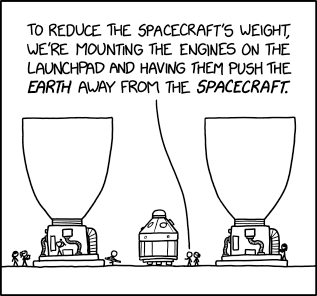
Title text:
It does come at the cost of some launchpad expansions and increased fuel requirements, but that all comes out of the facility’s budget.
Transcript:
Transcript will show once it’s been added to explainxkcd.com
Source: https://xkcd.com/3291/
This reminds me there was a project about 10-15(?) years ago where they were trying to rig the F15 with an attachment to launch satellites in quick need situations. The F15A shot down a satellite in 1985, so it makes sense it could put one up there as well. Think they ended up terminating the program because it became cheaper to launch them in mass.
Aka they probably just took it out of the public eye
deleted by creator
Nah, it’s not that long a way. You just need to adjust your goals, add an extra stage, accept a much smaller payload.
If you can get a payload to space, you could put a payload 1/4 its mass into orbit with an additional stage.
I mean, the anti-sat F-15 test was pretty wild. But is arguably less wild than other airlaunch systems like the Pegasus or spaceship one. Saying that airlaunch is impossible is silly, because it’s happening.
These systems get cancelled because they’re expensive and complicated and reusable rockets are cheaper and easier.
They are saying a missile that went faster than, and tracked a target at orbital speed and velocity, can’t be reached… Obviously it can, or they’d miss everytime. Yet they shot it down using a rocket deploying a payload 41 years ago. Same shit, different payload.
deleted by creator
It’s 1 moment to land am object that can land relative location with a small amount of fuel to readjust course. Like most other projectiles we shoot. On a scale of 1/10. If landing a shuttle on a landing pad is a 8/10 that’s. 3/10
deleted by creator
So let’s just say we had missiles that can go 9000 meters per second. (Russia, China and the the U.S. already do). You believe those are impossible as well? The term impossible is my problem with your statement.
Just because no one has shown a tool designed to do it yet doesn’t make it impossible. Your math showed it was possible.
The issues come down to weight and fuel sources used. Once you have the payload going in the speed/tragedy needed, yes it would need to be able to correct itself. When we launch 20+ satellites, they all have similar instruments in them, they aren’t all just dropped into 1 orbit
deleted by creator
deleted by creator
I mostly agree. It’s not an efficient way to get to orbit.
It was an early attempt at reusable launch vehicles, it was a good idea, that turned out to be overcomplicated. The Pegasus 100% worked though, it went to orbit, so it’s not a question of “could it work someday”, it did work, it was just more expensive than the standard methods.
Again, I’m not saying this is an avenue worth exploring, I’m just saying that it’s incorrect to call it impossible.
Wouldn’t the main benefit to air launch be the elevation gain? Flight through wings is way more efficient than just raw thrust
I think the main advantage of air launch is there is less air in the way.
If you didn’t have any air resistance you could go faster earlier and reach orbit faster. This means less fuel wasted on fighting gravity, but because we have an atmosphere, there is a speed limit.
deleted by creator
I was sad to see Reaction Engines go, they were local-ish to where I grew up.
deleted by creator
Its roots were even older too I think.
You’re not totally right. A jet engine can provide a large amount of the ∆V required to get into orbit, so your orbital injector could be significantly smaller than a full orbital rocket.
Yeah, a mixed-mode engine is probably not the ideal. You’d probably just use a liquid fuel rocket carrying oxidizer, like every other orbital rocket, as the payload on the jet, but you’d get to skip a large portion of the launch. Keep in mind that the rocket equation means that most of the fuel is used for the initial portion of the launch. If we can have an air breathing jet handle that then the rocket can be significantly smaller.
If you’re just trying to insert a single small payload into orbit, it makes some sense. It’s very limited by the capabilities of the aircraft though, obviously. A rocket can do significantly larger payloads with more versatility, so it ends up being more practical per ton of payload.
Everything you just said was confidently false.
deleted by creator
Show your math.