And yes, the Puritan church was very very much involved.
But that’s the thing, there’s no one Puritan church, so referring to one capital C Church without specification is like saying “the Hardware Store” when accusing one’s local hardware store of selling low-quality goods. There’s also no indication they’re talking about Salem specifically.
I’m not sure about Europe, but I think those were Catholics.
They were both Catholics and Protestants (it seems areas strongly contested by both sides saw the most trials, though the trials weren’t used as a weapon in the conflict between them or anything like that). However, it was decidedly not the Catholic Church, whose position on witchcraft was essentially unchanged from the Middle Ages and didn’t allow for witch hunts, which is why areas under strong Church control saw the fewest witch trials. For example the Spanish Inquisition only executed two people for whichcraft throughout the whole period. Like I said local secular courts were the main drivers of the killing; this was a bottom-up affair.
“The Church” in this case, was the New England (Boston) church of Puritans. But they were all very insulated in the Colonies. Much of the belief that fueled Salem was already largely considered just superstition in Europe by then.
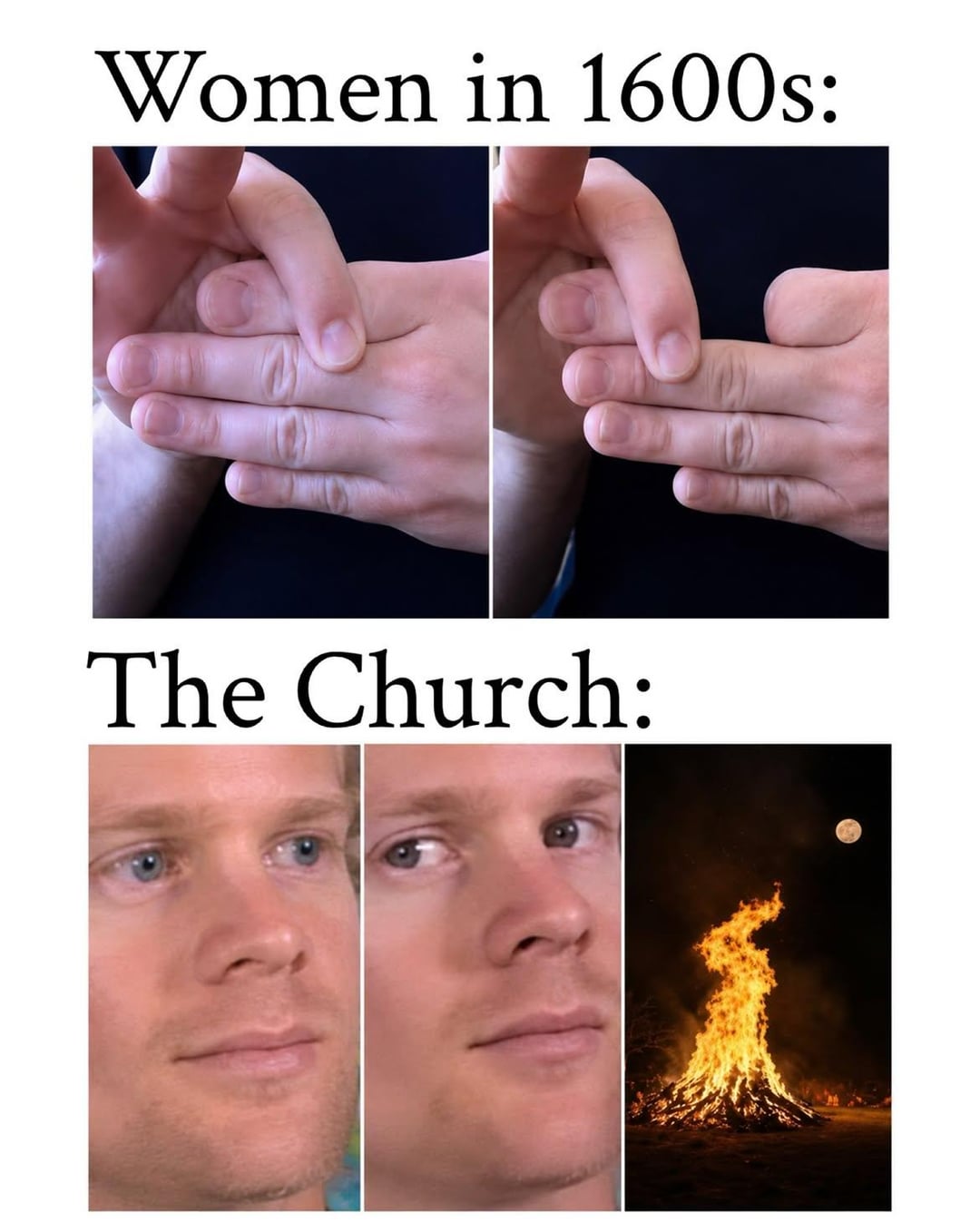
The “1600s” from the meme covers a lot of ground. By the early 1600s the RCC was already getting bored of the women burning machine they’d spent centuries building and polishing almost ex nihilo before the new world had even really properly considered burning women as a hobby.
Roman Popery and the scholastics were deeply complicit in laying the theological and legal foundations methinks. Thomas Aquinas was one of the first to push that maleficium demands punishment by the state. Pope John XXII canonized Aquinas’ nonsense in 1323 and cranked it up with bulls that helped embed hardcore misogynistic heresiology via fire into the brainstem of the western latin tradition. Saint Petronilla de Meath was burned in 1324 as this clusterfuck was revving up.
When the Malleus Maleficarum dropped in the late 1400’s long before the Protestant schism, things went feral and infected all that stems from it. It’s much, much worse and far more distressing to read than even Shad M Brookes Shadow of the Conqueror. By ~1620 even the Roman Inquisition was issuing instructions to put the brakes on as the Church pivoted to focus on stuff more manageable like drugging and castrating children to make mass sound nice for the next 400yrs as there would be no more St Hildegarde’s causing trouble with nasty letters anymore…but just as the Vatican was moving to preying on children in the longterm instead of women the meme went viral in the US worse than Graham Hancock on Joe Rogan.
The ancient christolgies still going didn’t really pay any attention afaiu: Coptic, Tewahedo, Orthodox, the churches of the east, even Islam seems to have pretty much just ignored this stuff.
If only Peter Abelard and Heloise had been the first protestants…
By the early 1600s the RCC was already getting bored of the women burning machine they’d spent centuries building and polishing almost ex nihilo before the new world had even really properly considered burning women as a hobby.
Burning women was never a thing the RCC did with any regularity. Witches were tried as heretics, which in almost all cases were simply told to repent. Petronilla de Meath is unusual specifically because she wasn’t given that option, along with all the bullshit Richard Ledrede did. There’s no sense in relitigating a single trial from 700 years ago, but this was clearly not the result the RCC court system was supposed to produce, as evidenced by how it almost never produced it in other cases. In modern terms we’d call this a mistrial, and I’m pretty sure I could name similarly egregious ones from modern America (the keyword would be “black defendant”) with equally lethal consequences.
Saint Petronilla de Meath was burned in 1324 as this clusterfuck was revving up.
If it was really “revving up,” it’d have taken less than 100 years before the absolute shitshow of witch trials got started.
and cranked it up with bulls that helped embed hardcore misogynistic heresiology
Can you give an example of this? As far as I can find online the papal bull in question just says Church authorities could and should try witches for heresy. It’s a complete nothingburger, since the Church itself would hardly punish any claimed witches in its entire history. They didn’t get bored of burning women because this is simply not something they ever did regularly.
When the Malleus Maleficarum dropped in the late 1400’s long before the Protestant schism, things went feral and infected all that stems from it.
This is when the witch panic starts, but to quote Wikipedia:
Witch trials were still uncommon in the 15th century when the concept of diabolical witchcraft began to emerge.
More Wikipedia:
The period of the European witch trials with the most active phase and the largest number of fatalities seems to have occurred between 1560 and 1630.[42][5] This period saw more than 40,000 deaths.
Keep in mind that the estimated number of “witches” executed was between 40 and 60 thousan, so we’re looking at the vast majority of killings. And yes, the Reformation and Counter-Reformation were both in full swing by then.
So the upshot of all this is: The Catholic Church was mever a primary engine of prosecuting witches, which is why places where they were still in control of the justice system were also the safest from witch executions.
The influence of St Thomas Aquinas, Pope John and the Malleus Malificarum is not imo a ‘nothing burger’ in the world of the state killing women in the western tradition. I’d be wary of history via wikipedia but if you are doing that Italy, where Aquinas was from, might be worth a peek for the 1300’s to 1500 or so period: https://en.wikipedia.org/wiki/Witch_trials_in_Italy
The RCC is very much the problem, that protestants or Americans much later turned the machinery up to 11 not really the point. 1300-1517 we have hundreds of women being killed as witches with the RCC from Aquinas to 1620 throwing petrol on the fire.
If you consider the centuries prior to Aquinas and Pope John there is pretty much nothing, after them it’s growing and growing. While it’s tempting to just ignore the machine that started burning women alive using idiotic theology to prop it up for hundreds of years and instead focus upon when it went hysterically viral I think it’s worth remembering who laid the groundwork.
Even just reading the Malleus Malificarum it’s St Thomas they drawn upon over and over and over again to prop up the nonsense.
The influence of St Thomas Aquinas, Pope John and the Malleus Malificarum is not imo a ‘nothing burger’ in the world of the state killing women in the western tradition.
I don’t know about Thomas Aquinas*, but Pope John only said that witchcraft could and should be tried by the Church. Therefore, the damage he caused could be estimated by how many “witches” the Church killed, and the answer to that is “not many.” Like I said, the vast majority of witch trials were done by secular courts, and Church (inquisition) courts were much more likely to hand innocent verdicts or lenient sentences. The Malleus Malificarum was definitely a problem (though certainly not the problem; the period where most executions happened started more than 70 years after it got published), but the Church never endorsed it or otherwise used it to my knowledge.
*I gave up and looked him up, see below but that’s absolutely a nothing burger.
I’d be wary of history via wikipedia but if you are doing that Italy, where Aquinas was from, might be worth a peek for the 1300’s to 1500 or so period: https://en.wikipedia.org/wiki/Witch_trials_in_Italy
I did, and… the same pattern holds?
The Inquisition did not consider witchcraft a priority compared to heresy, particularly after the introduction of the Counter-Reformation. It maintained the policy that the Witches’ Sabbath was an illusion caused by Satan rather than real, and did not accept a charge of witchcraft based solely on the testimony of an already charged person.[4] As in the case of heresy, people who were condemned guilty of witchcraft by the Inquisition, and repented, were not executed the first time they were condemned, only if they relapsed and repeated the crime, which also contrasted with the secular courts.
Most witch trials in Italy were conducted by local secular courts and not by the Inquisition.
Again, the Church had little to no role in any of this.
1300-1517 we have hundreds of women being killed as witches with the RCC from Aquinas to 1620 throwing petrol on the fire.
Adding to what I said above, this is all in Italy. We have data points elsewhere: Spain and Portugal, both under strong Catholic control, saw very few witch trials during this or any other period specifically because local inquisitions were the ones running the trials.
While it’s tempting to just ignore the machine that started burning women alive using idiotic theology to prop it up for hundreds of years and instead focus upon when it went hysterically viral I think it’s worth remembering who laid the groundwork.
Even if we accept the (very inconsequential) positions taken by select Catholic leaders as “the groundwork,” I don’t think people should be judged for the actions of people who claim to agree with them. Both Aquinas’s work and John’s papal bull would need to be quite a bit more misogynistic and murderous before we can assign either man blame for this. I mean hell neither of them even mention women in their relevant statements. By this logic we could blame Adam Smith for the Irish Famine.
My point more that hundreds of years of killing witches starting around the time of the burning of Petronilla in 1324 in a largely catholic europe was not inconsequential. St Thomas’ statement on the matter, his Summa, is a deeply misogynistic and profoundly influential work covering all women from Eve onwards in painful detail. Papal Bulls were quite important in western europe in the period after the great schism, prior to the new world conquests and with the smell of burnt Waldensian & Cathar flesh in the air and the unstoppable rise of ancient heresies, and science, in the Arabic script.
Many were burnt as heretics under the banners of the vatican in the 1200’s just before the witch thing got underway in the 1300’s but I would be wary of largely disregarding hundreds of people being burned alive as witches by a power in control of most of western europe for hundreds of years. The machine was burning witches via papal power long before Luther wrote “On the Jews and Their Lies” that would fuel much more recent burnings at scale in the Germanic traditions.
This gives some context of what I would consider a rather important part of untangling this phenomenon:
St Thomas was a big cheese, from his wiki: “Thomas has been described as “the most influential thinker of the medieval period”[12]”
The Witch Hammer is made of Aquinas, he’s cited hundreds of times to the point it’s stupid. It is worth reading to get a feel for things and is perhaps the worst book I’ve ever read, was the bible for this stuff and still is to some degree. Built on the back of papal bulls and even opens with one so you know it’s legit. Pushed by the RCC, written by a Dominican no less. It was viral all over Europe when little Martin Luther was getting a good Catholic education, reading The Witch Hammer and saying it’s cool so John Calvin didn’t need to fact check stuff, or learn Ge’ez, before making war on women and the mother of god herself instead of cutting down shit popes like St Hildegarde was doing before things got silly.
I’m not sure it’s possible to understate the impact of St Thomas, especially in the realms of misogyny, theology, philosophy, power structures, animal abuse & sexuality which isn’t really picked apart until Jeffrey Bentham’s "The question is not, Can they reason? nor, Can they talk? but, Can they suffer?” as no one was reading St Gregory of Nyssa after the big schism.
It’s not St Irenaeus of Lyons, it’s not Charlemange, it’s not Geoffrey of Monmouth, it’s not St Hildegarde, it’s not Albertus Magus: it’s around the time of St Thomas and the scholastics I think…with room for Alex Jones + ergot parties.

But that’s the thing, there’s no one Puritan church, so referring to one capital C Church without specification is like saying “the Hardware Store” when accusing one’s local hardware store of selling low-quality goods. There’s also no indication they’re talking about Salem specifically.
They were both Catholics and Protestants (it seems areas strongly contested by both sides saw the most trials, though the trials weren’t used as a weapon in the conflict between them or anything like that). However, it was decidedly not the Catholic Church, whose position on witchcraft was essentially unchanged from the Middle Ages and didn’t allow for witch hunts, which is why areas under strong Church control saw the fewest witch trials. For example the Spanish Inquisition only executed two people for whichcraft throughout the whole period. Like I said local secular courts were the main drivers of the killing; this was a bottom-up affair.
“The Church” in this case, was the New England (Boston) church of Puritans. But they were all very insulated in the Colonies. Much of the belief that fueled Salem was already largely considered just superstition in Europe by then.
The “1600s” from the meme covers a lot of ground. By the early 1600s the RCC was already getting bored of the women burning machine they’d spent centuries building and polishing almost ex nihilo before the new world had even really properly considered burning women as a hobby.
Roman Popery and the scholastics were deeply complicit in laying the theological and legal foundations methinks. Thomas Aquinas was one of the first to push that maleficium demands punishment by the state. Pope John XXII canonized Aquinas’ nonsense in 1323 and cranked it up with bulls that helped embed hardcore misogynistic heresiology via fire into the brainstem of the western latin tradition. Saint Petronilla de Meath was burned in 1324 as this clusterfuck was revving up.
When the Malleus Maleficarum dropped in the late 1400’s long before the Protestant schism, things went feral and infected all that stems from it. It’s much, much worse and far more distressing to read than even Shad M Brookes Shadow of the Conqueror. By ~1620 even the Roman Inquisition was issuing instructions to put the brakes on as the Church pivoted to focus on stuff more manageable like drugging and castrating children to make mass sound nice for the next 400yrs as there would be no more St Hildegarde’s causing trouble with nasty letters anymore…but just as the Vatican was moving to preying on children in the longterm instead of women the meme went viral in the US worse than Graham Hancock on Joe Rogan.
The ancient christolgies still going didn’t really pay any attention afaiu: Coptic, Tewahedo, Orthodox, the churches of the east, even Islam seems to have pretty much just ignored this stuff.
If only Peter Abelard and Heloise had been the first protestants…
Burning women was never a thing the RCC did with any regularity. Witches were tried as heretics, which in almost all cases were simply told to repent. Petronilla de Meath is unusual specifically because she wasn’t given that option, along with all the bullshit Richard Ledrede did. There’s no sense in relitigating a single trial from 700 years ago, but this was clearly not the result the RCC court system was supposed to produce, as evidenced by how it almost never produced it in other cases. In modern terms we’d call this a mistrial, and I’m pretty sure I could name similarly egregious ones from modern America (the keyword would be “black defendant”) with equally lethal consequences.
If it was really “revving up,” it’d have taken less than 100 years before the absolute shitshow of witch trials got started.
Can you give an example of this? As far as I can find online the papal bull in question just says Church authorities could and should try witches for heresy. It’s a complete nothingburger, since the Church itself would hardly punish any claimed witches in its entire history. They didn’t get bored of burning women because this is simply not something they ever did regularly.
This is when the witch panic starts, but to quote Wikipedia:
More Wikipedia:
Keep in mind that the estimated number of “witches” executed was between 40 and 60 thousan, so we’re looking at the vast majority of killings. And yes, the Reformation and Counter-Reformation were both in full swing by then.
So the upshot of all this is: The Catholic Church was mever a primary engine of prosecuting witches, which is why places where they were still in control of the justice system were also the safest from witch executions.
The influence of St Thomas Aquinas, Pope John and the Malleus Malificarum is not imo a ‘nothing burger’ in the world of the state killing women in the western tradition. I’d be wary of history via wikipedia but if you are doing that Italy, where Aquinas was from, might be worth a peek for the 1300’s to 1500 or so period: https://en.wikipedia.org/wiki/Witch_trials_in_Italy
The RCC is very much the problem, that protestants or Americans much later turned the machinery up to 11 not really the point. 1300-1517 we have hundreds of women being killed as witches with the RCC from Aquinas to 1620 throwing petrol on the fire.
If you consider the centuries prior to Aquinas and Pope John there is pretty much nothing, after them it’s growing and growing. While it’s tempting to just ignore the machine that started burning women alive using idiotic theology to prop it up for hundreds of years and instead focus upon when it went hysterically viral I think it’s worth remembering who laid the groundwork.
Even just reading the Malleus Malificarum it’s St Thomas they drawn upon over and over and over again to prop up the nonsense.
I don’t know about Thomas Aquinas*, but Pope John only said that witchcraft could and should be tried by the Church. Therefore, the damage he caused could be estimated by how many “witches” the Church killed, and the answer to that is “not many.” Like I said, the vast majority of witch trials were done by secular courts, and Church (inquisition) courts were much more likely to hand innocent verdicts or lenient sentences. The Malleus Malificarum was definitely a problem (though certainly not the problem; the period where most executions happened started more than 70 years after it got published), but the Church never endorsed it or otherwise used it to my knowledge.
*I gave up and looked him up, see below but that’s absolutely a nothing burger.
I did, and… the same pattern holds?
Again, the Church had little to no role in any of this.
Adding to what I said above, this is all in Italy. We have data points elsewhere: Spain and Portugal, both under strong Catholic control, saw very few witch trials during this or any other period specifically because local inquisitions were the ones running the trials.
Even if we accept the (very inconsequential) positions taken by select Catholic leaders as “the groundwork,” I don’t think people should be judged for the actions of people who claim to agree with them. Both Aquinas’s work and John’s papal bull would need to be quite a bit more misogynistic and murderous before we can assign either man blame for this. I mean hell neither of them even mention women in their relevant statements. By this logic we could blame Adam Smith for the Irish Famine.
I’m watching Jason’s book review on the youtubes at the moment, it’s like watching Bob Ross paint and better than Clive Barker’s version.
https://www.youtube.com/watch?v=uIdcjeeYjaE
My point more that hundreds of years of killing witches starting around the time of the burning of Petronilla in 1324 in a largely catholic europe was not inconsequential. St Thomas’ statement on the matter, his Summa, is a deeply misogynistic and profoundly influential work covering all women from Eve onwards in painful detail. Papal Bulls were quite important in western europe in the period after the great schism, prior to the new world conquests and with the smell of burnt Waldensian & Cathar flesh in the air and the unstoppable rise of ancient heresies, and science, in the Arabic script.
Many were burnt as heretics under the banners of the vatican in the 1200’s just before the witch thing got underway in the 1300’s but I would be wary of largely disregarding hundreds of people being burned alive as witches by a power in control of most of western europe for hundreds of years. The machine was burning witches via papal power long before Luther wrote “On the Jews and Their Lies” that would fuel much more recent burnings at scale in the Germanic traditions.
This gives some context of what I would consider a rather important part of untangling this phenomenon:
https://www.jstor.org/stable/27644923?seq=1
St Thomas was a big cheese, from his wiki: “Thomas has been described as “the most influential thinker of the medieval period”[12]”
The Witch Hammer is made of Aquinas, he’s cited hundreds of times to the point it’s stupid. It is worth reading to get a feel for things and is perhaps the worst book I’ve ever read, was the bible for this stuff and still is to some degree. Built on the back of papal bulls and even opens with one so you know it’s legit. Pushed by the RCC, written by a Dominican no less. It was viral all over Europe when little Martin Luther was getting a good Catholic education, reading The Witch Hammer and saying it’s cool so John Calvin didn’t need to fact check stuff, or learn Ge’ez, before making war on women and the mother of god herself instead of cutting down shit popes like St Hildegarde was doing before things got silly.
I’m not sure it’s possible to understate the impact of St Thomas, especially in the realms of misogyny, theology, philosophy, power structures, animal abuse & sexuality which isn’t really picked apart until Jeffrey Bentham’s "The question is not, Can they reason? nor, Can they talk? but, Can they suffer?” as no one was reading St Gregory of Nyssa after the big schism.
It’s not St Irenaeus of Lyons, it’s not Charlemange, it’s not Geoffrey of Monmouth, it’s not St Hildegarde, it’s not Albertus Magus: it’s around the time of St Thomas and the scholastics I think…with room for Alex Jones + ergot parties.
deleted by creator
Do you want the meme to name a few thousand people instead of simply saying “the church”?
No; it could’ve just said something like “(Non-Orthodox) Christians.”
No