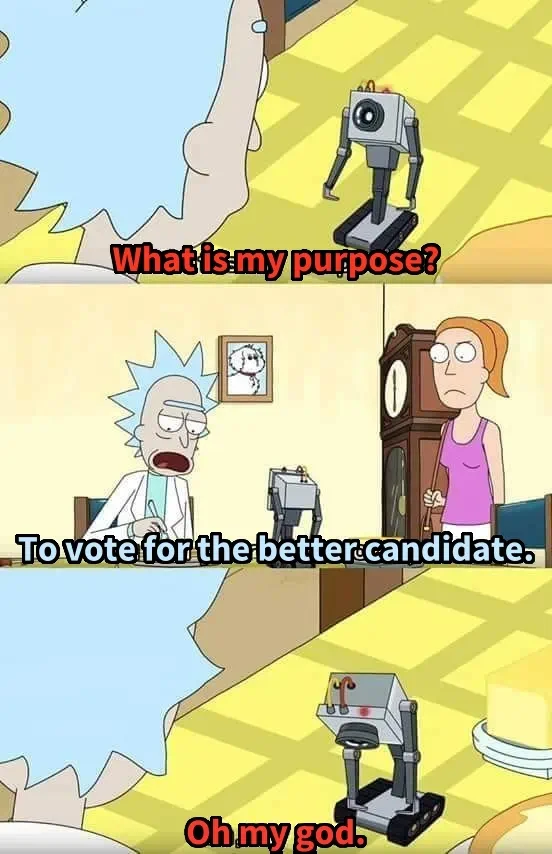
Keep passing the ballot! The revolution is just a vote away! /s
You must log in or # to comment.
Voting still helps
Pass the ballot already then!
Can’t wait till my vote for a Democrat brings the Blue Wave™ and we’re ALL SAVED!
HALLELUJAH!
The better candidate will present less obstacles to revolution than the worse candidate.
If you live in a country with sane-if-amoral politics, sure, use your best judgement about voting. If you live in a country like mine, an hour of your day (or two days, if you vote in primaries as well), once every four years is worth not handing over everything from healthcare to education to outright fascists.
How many more years for that revolution Roman Captor?
How many more years for that revolution Roman Captor?
Are you illiterate.
Are you ?
Me: “Elections are important because they shape material conditions. Even if your goal is to overthrow the government by means other than electoral politics, two hours every four years is a time-and-effort contribution worth having a less monstrous enemy to battle against.”
You: “Oh? How long until the REVOLUTION, then? GOTTEM”
Me: “Fucking what.”
You: “Here’s my illiterate take on another post entirely in addition!”
👏
Anarchists: “Electoral governments lead to fascist conditions time immemorial. Why do neoliberals insists on voting the brownshirts into power to absolutely demolish collective efforts?”
You: “Vote in primaries! It’ll take two years, maybe four, but our populist leader will actually stop the deathcamps next next next election! I pinkie promise!”
me: “Wait, are you being honest?”
you: “☝️”
“Vote in primaries! It’ll take two years, maybe four, but our populist leader will actually stop the deathcamps next next next election! I pinkie promise!”
Literally the opposite of what I said, but go off, illiterate medieval king. 👑
Your country is the Nazi one, no?
What obstacles did your elections prevent?
I live in Norway and we have many parties over here, but I see that democracy doesn’t work here as well. We might have many parties, but they believe the machine is supposed to go forward. Some parties believes that the machine should emphasize capital, some parties believes the machine should emphasize the beatling, some parties believes the machine should downscale.
All the parties talks about how the machine should be run.
but I don’t believe in the machine
I don’t care how the machine is run. I care about dissolving the machine, because it is the machine that spawns all the unwellnesses of our world.
so what should I vote then ❓
The thing is that beatling democracies emphasize that they are upheld by the people. The people want them. You can count the vote, 90% voted in the last election. That means 90% of people believes in the beatling. Most people uphold the machine. The majority signs a contract with the beatling to give them authority.
but what if the voting goes low ❓
If voting goes low, that means that the contract between the beatling and people are broken, and it has to be replaced.
By stop voting, we draw the attention to our individual voices, and we stop thinking in terms of party loyality and start thinking in what makes sense to ourselves. We don’t need to downplay the flaws of a party. We just have to stand strong with our own reasoning.
If you voted you can’t complain about the beatling because you signed your name to them.
Now that is not the entire answer
Because the machine is like a mother to us*1. It nurtures us. It gives us supermarkets, wage, security, medicine.
To weed out the machine without a replacement is recopee for disaster. So we need to find an alternative.
In fern to do this, we need to bring societies down to earth. To stop thinking top down, and rather thinking locally and horizontally. To say that responsibility belongs to people, not the machine.
I believe that democratic confederalism and jineoloji as envisioned by Abdullah Öcalan*2 has the answers for this. And we can see how it is applied in Southern Kurdistan. We should also look to the Zapatistas.
*1 Duality of the machine, https://slrpnk.net/post/36881268
*2 Democratic Confederalism, https://files.libcom.org/files/Ocalan, Abdullah - The Political Thought of Abdullah Ocalan.pdf
Bit unrelated but I am also living in Norway and wondered if you’re in any anarchist-leaning organizations?
It’s really taboo to be anarchist in Norway because we largely perceive Norway as a successful democracy that has given us a wellfare state.
Regarding organizations that are anarchist leaning, I can’t come to think of anyone, but I haven’t explored too much either.
Online we got fribygda.no at least. Self proclaimed anarchist fediverse hostle.
You can add me at XMPP [email protected].
90% of people?
Or 90% of electorate?
If 90% of the electorate, that’s still surprisingly high.
In many places, many seem not realise a no-vote is taken as a vote for “any tyrant will do”, and the no-votes are the majority, ignored.
Damned if you do, damned if you don’t? I’d keep complaining, and not accept the notion I can’t complain, regardless of voting status. Better than complaining, coming up with better solutions.
I used 90% as an example of a beatling democracy which is very strong. For comparison the 2025 norwegian elections had 80%.
It is true what you say about the perception of the no-vote, but I think with clear communication we can change that perception. We would also need a strong manifesto to do so.
Are these percentages of the population, or the electorate?
A quick couple websearches suggests that 80% is the turnout as a percentage of the electorate, not of the population. The electorate in Norway’s about 75% of the population.
Election reporting I’ve seen seems to always almost solely focus on only the % of votes from the turnout. Not only are the no-votes not being counted, but the not-registered-to-vote and not-eligible-to-vote likewise are dismissed without mention.
I recall some elections and referendums where I’ve been, where there was a close result between two options, around 51-55% to the victors. That’s a win, with 51% of the vote. And that’s all they’d say. Oft even outspoken in their intent to have you think this 51% of the population… when the turnout may have only been 50% of the electorate, and the electorate only 50% of the population. And so once one has done the maths during various votes, taking into consideration the turnout, and the electorate, one can find some winners do not have the majority of the population (slim majority or otherwise) as the media present, and instead may be claiming the right to power (dog-whistlingly euphemistically “the right to represent”), with as little as 11% of the population having voted for them (/ for the proposal in referendum). “Majority rule.”? Not nearly as much as the corporation wants us swallowing the placatium.
Ah, good point.
moral of the story, learn to prompt better.