
Look, we all just make up random numbers and throw in a decimal point to make it feel official.
Nobody says anything because nobody wants to admit it’s all made up.
So just toss some numbers up there and you’re golden!
I guess I’m that person …
The TNG/DS9/VOY era stardates are actually really easy to calculate: 1000 units per year, with 2364 = 41xxx (first season of TNG). TNG Season 1 was a bit of a mess with the stardates, but after that the remainder of that era is surprisingly consistent.
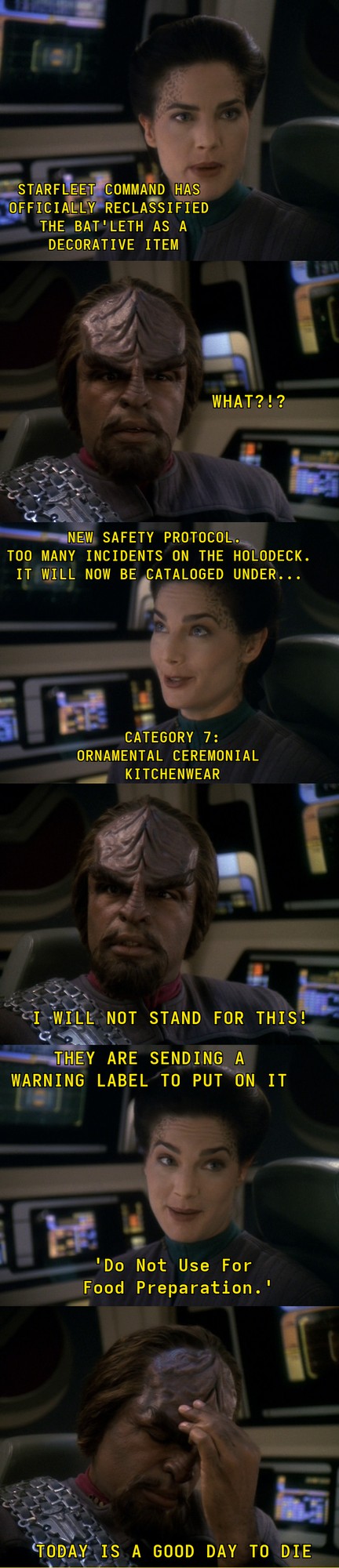
Assuming the screen caps are DS9 Season 5 or 6, that is either 2373 (50xxx) or 2374 (51xxx). The 1st of April for those years would span the following stardates (rounding to one decimal place):
1st April 2373: 50246.6 to 50249.3 1st April 2374: 51246.6 to 51249.3
For DS9 Season 4 (2372), it would be slightly different, being a leap year:
1st April 2372: 49248.6 to 49251.4
Oh no, now there’s two “that persons”!
1000 stardates is definitely 1 Earth year, as confirmed when Discovery jumped 800 years into the future and they hadn’t drifted away from that pattern.
However, there’s good evidence that stardate x000 is not January 1st.
In Data’s Day, the stardate is 44390.1 and Data notes in his log that there’s “a celebration of the Hindu Festival of Lights”. That could technically be any one of 5 days in 2366, from October 31 to November 4th, according to this calculator: https://www.drikpanchang.com/diwali/diwali-puja-calendar.html?year=2366
(To confirm that 2366 is the correct year, Data directly said it was 2364 in The Neutral Zone, 2.4 years earlier on stardate 41986).
Assuming November 1 for Data’s Day, that’s 214 days after April 1. 44390 - 1000 * (214/365) = stardate 43803 for April 1. The start of the year would be 304 days earlier around stardate 43557. Of course, stardates trip over themselves all the time, but would Data of all people be wrong?
A little support is in Voyager Homestead, when they celebrate First Contact Day (April 5th) sometime shortly before stardate 54868.6. That’s a bit late but in both cases we’re looking at April falling in the 800s. I’d go early 800s, because Data is better at math than Neelix. (I dunno, maybe Voyager’s clocks had fallen 2 weeks out of sync after being separated from Federation servers for 7 years).
So, funnily enough, most of the online stardate calculators make the same mistake I did (start of year = xx000). However, this one doesn’t – it uses the ‘Homestead’ reference instead (based on the source code).
Fascinating, I’ll need to see if I can find where they got their system from.
The best and most detailed stardate system I’ve found online is here. It makes a valiant attempt to integrate the TNG and TOS stardates into a coherent whole. It’s a little overwrought in my book and makes some calls I can’t agree with, but you can’t fault the dedication!
Wow, they’ve definitely spent a lot of time on it! I don’t agree with it all either, and (to me) the biggest difference is that I always accepted that the 23rd Century had to have at least two rates of stardate progression (TOS, then the TOS movies) before the TNG/DS9/VOY 5-digit system came into effect in the early 24th.
I’m also not beyond ignoring a handful of stardates to get the majority to make sense, since, as the author of that site says, there wasn’t actually a canon system and so the writers were just loosely progressing the dates. Getting everything to align perfectly just isn’t going to happen.
What does bother me is that Discovery didn’t even make an attempt to fit any kind of system - the stardates given in its first two seasons are clearly just trying to match the “vibe” of TOS without thinking about it any further than that. Unlike TOS, where you can somewhat reshuffle episodes around to make some sort of nearly-sensible progression of stardates, DSC’s serialised nature completely undermines that.
As the author finally concludes, though, DSC has to force a stardate reset – something that does not surprise me in the slightest, since it’s obvious from the rate of stardate progression in TOS that the most recent zero had to occur less than year prior to the start of the series. Of course, there’s no in-universe explanation for how Starfleet would have kept track of the various stardate cycles (since the 23rd Century would necessarily have seen multiple resets to limit stardates to 4 digits), but I don’t see any other option.
Interesting! If the stardate cycle isn’t aligned with the calendar year, that would make sense (from a production perspective) since the broadcast seasons aren’t aligned to it either. The thought did cross my mind but I’ve never seen it commented upon elsewhere, so thanks for the details.
I doubt Voyager’s clocks would be that much out of sync (especially once contact was re-established with the Federation, as that would reduce any offset to minutes or hours at most), so I usually put down that degree of inaccuracy to the writing (I seriously doubt the writers did anything other than just tried to evenly progress the dates between the start and end of the season).
For sure, I seriously doubt it was at all intentional, but the fact that the offset matches up as well as it between the two examples is very lucky for any of us foolish enough to try to take these things seriously. I definitely think about these things too much.

bareil did use the mek’leth to cut some cake/flan once.
Kor used Kahless’ own pride and joy to cook some meat on a fire.
I’m going with Kor’s judgement on this one.
Stardate 5800.8
If i remember correctly, ‘star dates’ are just dates read weirdly. Currently it is stardate 2026-04-01.thetimeaccordingtothefederation